

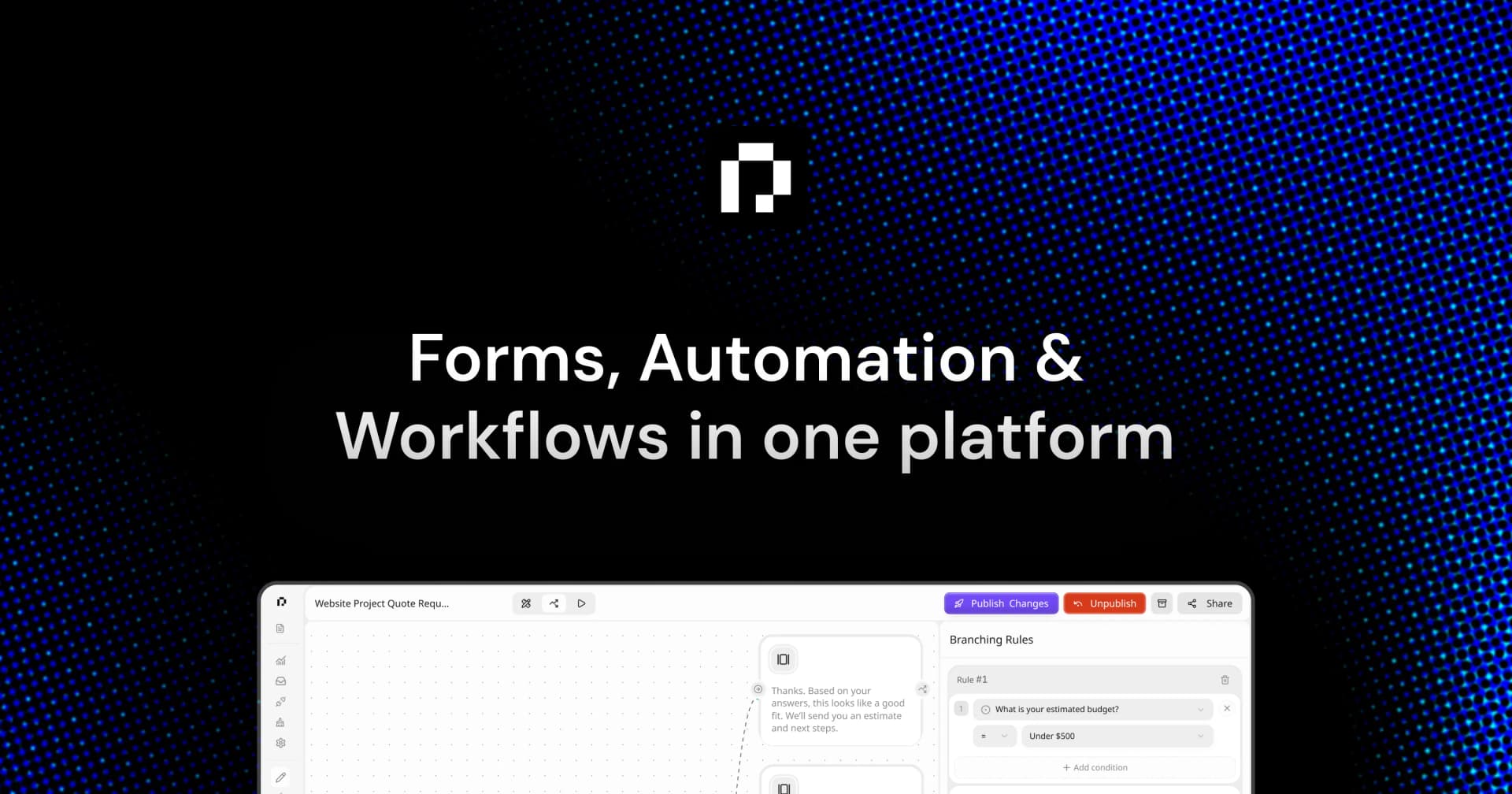
A form-workflow platform for freelancers and agencies - not a form builder, a routing engine that happens to start with a form.
Why I Built This
The form builder market is crowded. But almost every product in it treats data collection as the destination - not as the beginning of a workflow. The moment someone hits Submit, most tools are done with you.
Someone still has to manually email the right people. Chase missing documents. Wait for approval. Trigger the next step. Log it somewhere.
That's not a form problem. That's a routing problem. And no one was solving it cleanly.
The Beachhead
I didn't go wide. I narrowed to the smallest group who felt this acutely - freelancers and small agencies doing client onboarding. They collect contracts, briefs, files, payment details, and approval sign-offs - every project cycle, manually, every time.
The insight that locked the vertical in: for this group, the form is their first client touchpoint. A clunky intake form signals something before a word of work is done. Premium UI isn't vanity here - it's a trust signal.
That framing shaped every product and design decision that followed.
Architecture Decisions
These were made before writing the first line of code. Each one would have been expensive to undo.
Single directed graph JSON model under both editors Pabble has two workflow editor modes - a linear builder and a node canvas. Both are views of one data structure. Made this call to avoid dual models drifting out of sync. More upfront complexity. Eliminates an entire class of future bugs.
Three separate Next.js apps, not a monolith Marketing, dashboard, and form renderer are independent deployments. The form renderer runs in contexts the dashboard never touches - embedded, shared links, custom domains. Splitting early let each app optimize for its own performance profile.
Go for the backend, not Node Go Fiber for routing, GORM as the ORM over Postgres. The backend handles webhook delivery, queue processing, file operations, and email triggers - concurrency-heavy work. Go's goroutine model handles this with less overhead than Node's event loop at the same scale.
Async everything via SQS + dedicated worker Form submissions never block waiting for downstream events. A Go worker consumes from SQS and handles notifications, webhooks, email dispatch, and special events independently. API response time stays clean. Submission experience is instant.
Self-managed VPS over managed cloud Hostinger VPS + Coolify instead of Render or Railway. Full infrastructure control, Docker-based, self-hosted CI/CD. Chosen deliberately - understanding your own infra is a skill, and abstraction layers you don't understand eventually cost you.
The Full Stack
| Layer | Technology | Why |
|---|---|---|
| Frontend | Next.js (×3) | Isolated apps per concern - marketing, dashboard, form renderer |
| Routing | Go Fiber | Fastest Go HTTP framework; Express-like API without Node overhead |
| ORM | GORM + Postgres | Full-featured, idiomatic Go - migrations, associations, hooks |
| Queue | SQS | Durable at-least-once delivery without running a broker |
| Files | Cloudflare R2 | S3-compatible, zero egress fees - critical for file upload forms |
| Cache | Redis | Session state, hot-path caching, rate limiting |
| Resend | Developer-first transactional email, real deliverability | |
| Deploy | Coolify + VPS | Full infra control, Docker-based, self-hosted CI/CD |
Product Design Thinking
Three editors, not one The product has a Form Editor, Flow Editor, and Action Editor (in progress). That's not a feature count - it's a statement about how the problem is layered. Each editor owns a distinct concern.
Form Editor Shader-rendered backgrounds, premium component design, intentional transitions. Not for aesthetics - because for freelancers and agencies, the intake form is part of the service they deliver. It reflects on them.
Flow Editor Dual-mode: linear builder as default, node canvas as opt-in. Most similar tools lead with the canvas. I defaulted to linear because canvas-first interfaces kill activation - steep learning curve, slow time-to-first-workflow. Linear gets you to a working flow in under five minutes.
Dashboard Designed against the typical SaaS admin pattern. Closer in spirit to Claude or ChatGPT's interface - everything surfaced, nothing buried in nested sidebars. 3–4 clicks to anything.
Workflow Vocabulary
Before writing any workflow logic, I identified the smallest set of primitives that could express any business process without needing escape hatches.
| Step | Purpose |
|---|---|
| Collect | Gather structured input from a person |
| Notify | Alert a team member or external party |
| Approve | Gate the next step behind a human decision |
| Wait | Pause the flow for time or an external condition |
| Branch | Route the workflow based on data or conditions |
| Generate | Create a document or artifact automatically |
| Charge | Trigger a payment at the right point in the flow |
| Connect | Integrate with an external tool or API |
Eight primitives. Enough to express any real workflow. Small enough to stay coherent. Defining this vocabulary before building features forced precision - every request either maps to a primitive or it belongs to a different product.
What This Demonstrates
Pabble is notable not because it's a form tool but because of the chain of reasoning required to build it:
- Identifying a real gap inside a crowded, well-funded market
- Narrowing to the right beachhead before building anything
- Making structural architecture decisions that hold under growth
- Shipping production infrastructure - frontend, backend, queue, storage, email, deploy - without a team
Every decision here was made on reasoning, not on user research confirming it first. That's the skill this project is meant to demonstrate.
TL;DR
- The form builder market is crowded but nobody was solving the routing problem after submission
- Narrowed to freelancers and agencies doing client onboarding as the beachhead
- Three independent Next.js apps, Go backend, SQS for async processing, R2 for file storage
- Eight workflow primitives that cover any real business process without escape hatches
- Solo founder · Full-stack · Live beta · 2026